
A
WORD FROM RBO's EDITOR:
We are pleased to have
many visitors from around
the world on this page.
Please, feel free to
download the audio-file
and to use it cost-free.
However, this will be
under the condition that
you inform RBO about
intended use by sending a
mail to: radiobridge@aol.com
Any other feedback would
also be appreciated.
The copyright remains
with RBO. |
"MAKING
IT WORK"
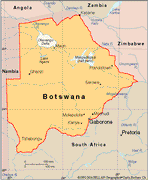
IN BOTSWANA
- EPISODE B
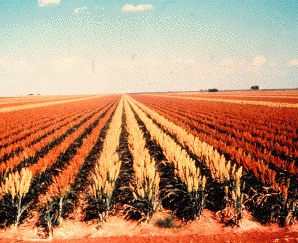
Sorghum
provides an important
component to the diets of
many people in the world
in the form of unleavened
breads, boiled porridge
or gruel, malted
beverages, and specialty
foods such as popped
grain and beer. Syrup is
made from sweet sorghum.
The crop is also used for
building material,
fencing, fodder for
animals, or for brooms.
In 1994,
sorghum ranked fifth
among the most important
cereal crops of the world
after wheat, rice, maize
and barley in both total
area planted and
production. Eighty
percent of the area
devoted to sorghum is
located within Africa and
Asia.
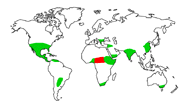
Sorghum originated in the
north-eastern quadrant of
Africa, where the
greatest variability in
wild and cultivated
species is found to this
day. The first steps
towards domestication
took place in the area of
the Sudan and Chad
between 5,000 and 7,000
years ago. From this
center of origin, it was
distributed along trade
and shipping routes
throughout Africa, and
through the Middle East
to India at least 3,000
years ago. It reached
China along the silk
route. Sorghum was first
taken to the Americas
through the slave trade
from West Africa. It was
reintroduced in late 19th
century for commercial
cultivation and has
subsequently been
introduced into South
America and Australia.

Sorghum has a very hard
kernel. This makes it
resistant to disease and
damage but also requires
further processing to
enhance its feeding
efficiency. Sorghum is
ground, cracked, steam
flaked, roasted,
micronized, or
reconstituted. These
processing techniques
will enhance the
nutritional value of
sorghum by 12-14 %.
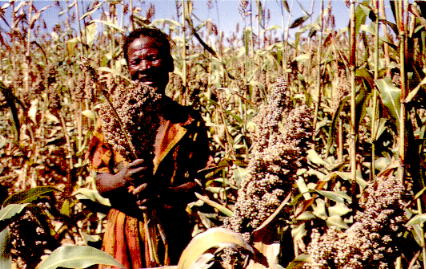
In rural Botswana the
majority of people are
engaged in agriculture to
improve their
socio-economic
lifestyles. Nevertheless,
the lack of an
appropriate technological
capacity in the areas of
cultivation, weeding,
harvesting and processing
has in many ways
frustrated the rural
economic sectors effort
in increasing
productivity and income
earning opportunities for
its target population. In
spite of these
shortcomings, agriculture
continues to be
emphasised within the
government's planning
strategies, concomitant
with the ever increasing
support from
non-governmental
organisations.
Rural
Industries Innovation
Centre
Among these
non-governmental
organisations is the
Kenya based Rural
Industries Innovation
Centre (RIIC) in the
Southern District of
Botswana. RIIC has made
commendable breakthrough
in the development and
dissemination of
appropriate technologies
to increase the
effectiveness of
agriculture to the rural
economic sector. More
importantly, agriculture
is made a more
economically rewarding
occupation.
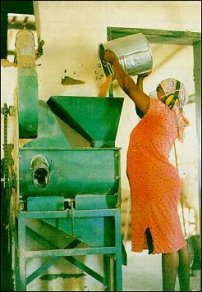
RIIC has achieved a
glittering breakthrough
in the development and
dissemination of the
sorghum dehuller, which
is designed to relieve
women and children of the
laborious and time
consuming hand stamping
drudgery in rural areas.

The sorghum dehuller
decorticates dry sorghum
through measurable bran
extraction. The principle
employed is that of
progressive abrasion of
the outer layers of
grains throughout the
dehuller barrel. The
grains so decorticated
are then funneled to the
hammermill which converts
them into the flour. The
flour produced is
distributed to the retail
outlets for sale to the
members of the public.
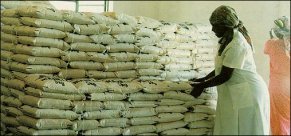
The net result of the
sorghum milling industry,
which has hitherto grown
to 56 operations
nationwide, has been the
creation of 224 jobs,
most of which are held by
women who also perform
leadership roles in most
of these operations. In
addition, the sorghum
dehuller has been
exported to ten African
countries: Lesotho,
Malawi, Mali, Namibia,
Senegal, South Africa,
Swaziland, Tanzania,
Zambia and Zimbabwe.
The confidence in the
sorghum dehuller within
the international
community rendered itself
in 1986 when the
technology got first
prize out of 27
competitors in a
development technology
competition mounted for
technologies from
developing countries in
Genoa, Italy.
"An
End to Pounding / L'Adieu
au pilon"

The
National Film Board of
Canada has produced a
film which details how
researchers in Canada and
Africa have produced a
novel mechanical dehuller
that can process sorghum
quickly and cheaply,
making it as convenient
to eat as other grains.
For more details, click
on the pictures above.
GEORGE
MSUMBA OF RBO
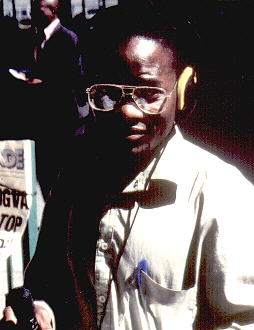
REPORTING FROM BOTSWANA
"How
to grind your sorghum
into a fine, healthy
meal"
13'19" / LISTEN

You can go
back to the introduction
page by hitting the
button above.

You can go to the next
episode by hitting this
button,
or you access episodes of
your choice by clicking
on one of the thumbnails
below.


|


