
A
WORD FROM RBO's EDITOR:
We are pleased to have
many visitors from around
the world on this page.
Please, feel free to
download the audio-file
and to use it cost-free.
However, this will be
under the condition that
you inform RBO about
intended use by sending a
mail to: radiobridge@aol.com
Any other feedback would
also be appreciated.
The copyright remains
with RBO. |
"MAKING
IT WORK"
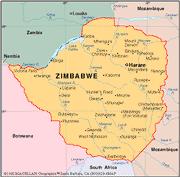
IN ZIMBABWE - EPISODE B
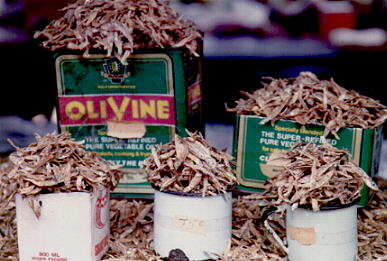
Poor nutrition in
sub-Saharan Africa is
often linked to a lack of
fat in people's diets.
Fat is required
to help absorb vitamins,
proteins, and other
nutrients. Ten of the 20
countries with the lowest
per capita visible oil or
fat intake in the world
are in eastern and
southern Africa. Rural
people, especially
children and nursing
mothers, are the most
likely to suffer from
poor nutrition.
As recently
as 1987, 80% of the
vegetable oils and fats
consumed by the
population in Kenya were
imported. The intake of
edible oils remains low,
affecting people's
nutrition and health.
Production of oilseeds,
such as sunflower and
sesame, has traditionally
been minimal, and rural
oil processing has been
virtually nonexistent.
The rural population's
need for oil and animal
feed have been met by
urban processors at high
cost. Structural
adjustment programs in
many African countries
have exacerbated the
situation, creating an
even greater need for
enhanced food security,
as well as enterprise and
employment opportunities.
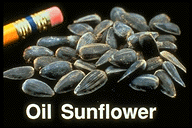
Sunflower is used
primarily for the
production of vegetable
oil, preference being
given to those hybrids
with a high oil content.
Sunflower is a crop with
some resistance to
drought and can grow well
in marginal rainfall
areas. The crop is also
relatively quick maturing
and can give good yields
when planted later than
most crops.
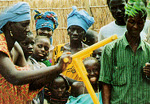 Introducing small-scale
processing equipment in
rural areas helps reduce
the need for cash to buy
oil. Local production of
cooking oil from
sunflowers and other
common oilseed crops
improves the nutritional
levels of both people and
livestock by supplying
necessary dietary fat.
Oil production can also
increase farmers'
incomes, and create
enterprises and
employment for farmers
and oilseed press
operators. In fact, local
entrepreneurs involved in
small-scale oilseed
processing can earn two
to three times more gross
income, as compared to
selling their product to
large processing
companies or marketing
boards.
Introducing small-scale
processing equipment in
rural areas helps reduce
the need for cash to buy
oil. Local production of
cooking oil from
sunflowers and other
common oilseed crops
improves the nutritional
levels of both people and
livestock by supplying
necessary dietary fat.
Oil production can also
increase farmers'
incomes, and create
enterprises and
employment for farmers
and oilseed press
operators. In fact, local
entrepreneurs involved in
small-scale oilseed
processing can earn two
to three times more gross
income, as compared to
selling their product to
large processing
companies or marketing
boards.
Researchers
and development
specialists working with
Appropriate Technology
International (ATI) have
developed a method to
introduce small-scale oil
expelling enterprises to
rural areas in Africa. A
typical set up consists
of a ram press for
extracting the oil, a
filtration device, tools
for maintenance, and
perhaps most importantly,
training, support, and
information on proper use
of the oil and cake (the
residue of the seeds
after the oil has been
squeezed out), and the
socioeconomic and
nutritional benefits of
an oilseed processing
enterprise.
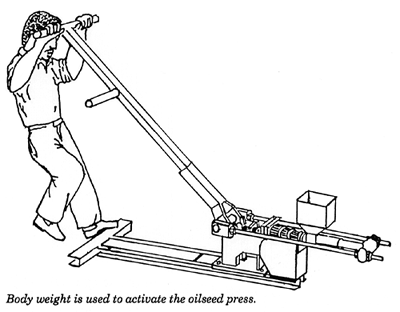
The ram press, driven
manually by a long
handle, consists of a
small piston that presses
a measured load of
oilseeds into a metal
cage. The basic design
was developed in Tanzania
in 1985 by Carl
Bielenberg of ATI. The
original and improved
versions are now widely
used there, as well as in
other African countries.
The press's design has
been continuously refined
over the years, so that
the original, large,
two-man machine has
evolved into a smaller,
less expensive model that
can be operated by one
woman.
For more information
visit:
The
International Development
Research Centre
Radio Bridge Overseas
invites you to Mutoko,
the land of the granite
domes and mango trees in
the Mashonaland district
of Zimbabwe. There you
will meet some people who
are earning a living from
making oil out of
sunflower seeds for
themselves and their
community.
Contact in Zimbabwe:
Dr. Ernest
Mupunga, Director
Oilseed Programme
Appropriate
Technology International
- East and Southern
Africa
62 Livingston Avenue,
Second Floor
New Haven House
Harare, ZIMBABWE
Tel: (263) 4704813 or
4704815
Fax: (263) 4704816
E-mail: mupunga@ati.icon.co.zw
GEORGE
MSUMBA OF RBO
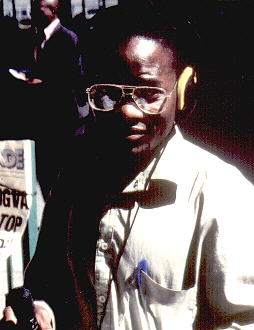
REPORTING FROM ZIMBABWE
"How
to make money out of
oilseed"
15'00" / LISTEN

You can go
back to the introduction
page by hitting the
button above.

You can go to the next
episode by hitting this
button,
or you access episodes of
your choice by clicking
on one of the thumbnails below.


|


